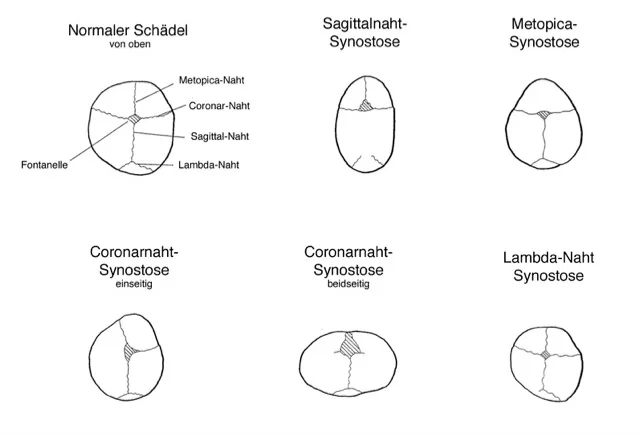
The consequences of synostoses, skull deformities and other possible malformations that can occur in connection with a syndrome are
- Aesthetically problematic cranial deformities, which can lead to social exclusion and stigmatization
- Development of increased pressure in the head - "intracranial pressure"
- An eye socket that is too shallow
- Underdevelopment of the midface
- Accompanying malformations of the brain, extremities and internal organs
- Developmental delays (inconsistent, depending on the clinical picture)
Very conspicuous skull deformities often have a disfiguring effect and can lead to social exclusion in later life. Even with isolated suture synostosis, further skull growth is likely to lead to an increase in skull deformities, which can stigmatize and thus impair the affected child. For this reason, the aesthetic aspect is particularly important in isolated suture synostosis.
If the brain develops normally, the growth inhibition of the skull caused by suture synostosis can lead to an increase in intracranial pressure. The extent of this increase in intracranial pressure depends primarily on the number of sutures affected and the time of ossification.
Recent studies at our clinic have shown that premature ossification of a single suture, particularly the sagittal suture, can also lead to more pronounced increases in intracranial pressure in up to 80% of children. It is unclear whether and, if so, to what extent this impairs brain development. The occurrence of a more severe increase in intracranial pressure ("intracranial pressure") with the development of classic "intracranial pressure symptoms" is very rare in the case of isolated suture synostosis, but more common in the case of closure of several sutures. There is evidence in the literature that children who were operated on earlier for sagittal suture synostosis (before the age of 6 months) had on average better cognitive function after 10 years than children who were operated on later (after 12 months).
Severe forms of craniosynostosis, as seen in syndromes, may be associated with underdevelopment of the orbits and midface. An underdeveloped and shallow eye socket can lead to incomplete closure of the eyelids with strongly protruding eyes and thus endanger the cornea through dehydration and inflammation. Underdevelopment of the midface can lead to constriction of the airways, which can result in sleep apnea syndrome at night. Other problems that can be associated with an underdeveloped midface include Middle ear infections and hearing loss, incorrect jaw relation with the upper jaw being set back, lack of space for the teeth and impaired chewing function.
In syndromes, further malformations must be expected, such as developmental disorders of the brain, inner ear hearing loss, fusion of fingers and toes (so-called syndactyly) and cleft palate, slipping of the cerebellum due to a too small head into the spinal canal (Chiari 1 formation) or an obstruction of blood outflow from the skull.